
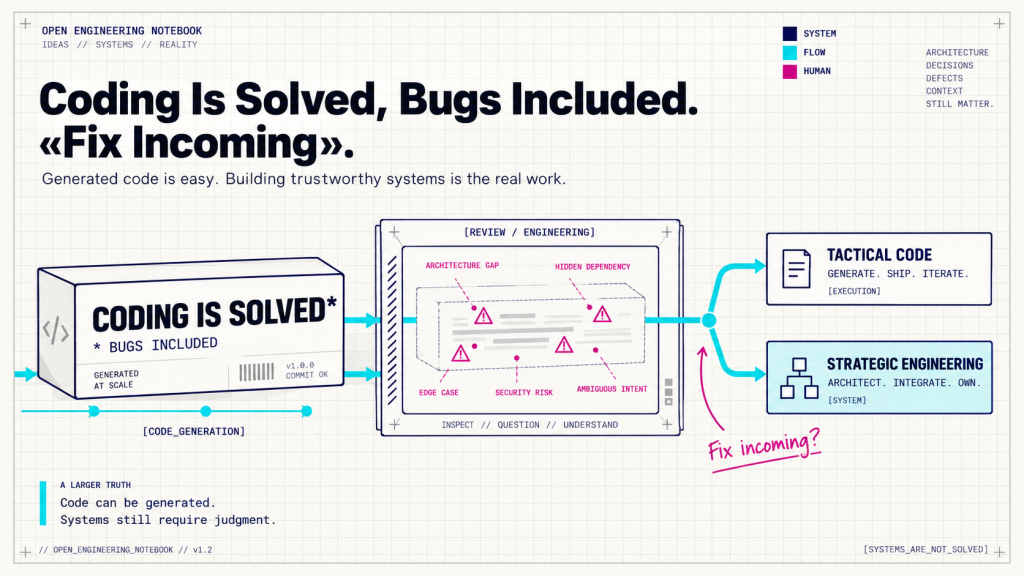
Did it blow up, or is the wave just starting to form?
When this post showed up in my X feed, my first thought was that we’d be hearing about a new Claude Code release very soon. After reading the replies and sitting with it for a while, I think the real intention was different: stir the hornet’s nest and push the conversation one level further.
What do I mean by one level further? Until now the story went like this: developers won’t write lines of code anymore, they’ll review, contribute architecture, guide the work. And by developers we meant senior developers, because juniors were already out of the picture, coding agents had absorbed that work. Put all of that in quotation marks, obviously.
Now the creator of Claude Code is steering the conversation towards agent-generated code that is on its way to having no bugs and needing no review. Which raises the uncomfortable question: are the senior developers doing the reviewing next on the replacement list?
How does that land with you?
What Cherny is actually saying
Scratching past the sensational reading (although where there’s smoke there’s fire, or better said, the wave is starting to form), what interested me was the underlying debate: which areas of engineering can coding agents realistically reach?
Cherny’s own words are that in the future models will produce bug-free code with great architecture and UI, and then he adds the caveat that getting there takes time, effort and research.
What nobody can dispute is that frontier models keep getting more capable and keep delivering better code. Still with mistakes, yes, but improving fast, and not only when churning out lines of code. Architecture and UI are improving too.
The roadmap, and where we are on it
The way Cherny lays out the path (past and future) goes through three stages. First, models code better than we do. Second, models handle the engineering work adjacent to coding better than we do: debugging, profiling, optimisation, bug fixing, system design, abstraction design, UI design, generating ideas. Third, models do most things that can be done on a computer better than most people.
He may be talking his own book, but his vantage point in terms of capabilities and resources is hard to argue with. Stage one is done. Stage two is not fully there, but a large part of it is, hence the talk about bugs and fixes. For stage three he sees early findings, nothing more yet.
Where do you sit on the curve?
This is the point where some self-reflection is due. Cherny is already doing it. His framing is that models are walking through the distribution of human capability. He describes himself as an average programmer and admits that Claude has already overtaken him in quite a few tasks. That doesn’t mean it has overtaken every developer, not yet, but the frontier keeps moving and leaves more professionals on the other side each time.
Think about it: if someone with Cherny’s profile says that about himself, where does that leave the rest of us? Where does it leave you?
And here I’ll press on the sore spot, because the Business Central world is fertile ground for ego and deification. As an AL developer, how do you rate yourself against that statement? Anything short of «high» or «very high» (the «I’m indispensable» stance that is so common in the BC community) amounts to accepting that coding agents have already passed you.
I have never considered myself a programmer, or at least it was never my focus, and I have certainly never considered myself an expert. Yet since the wave arrived I’ve been doing far more coding-related work than before, and ALDC is a direct result of that. And every day I feel the frontier getting a little closer to me.
The pushback: tactical versus strategic coding
So what happened, or what is happening now? The reaction you’d expect. At the beginning there were people insisting that bulk code written by humans would never go away, because agents made too many mistakes, because they were worse than a novice developer, and so on. Then it happened, as we all know. Those same people now distance themselves by agreeing with stage one (models code better than we do) while flatly rejecting stage two.
The debate is on, and I think it’s a necessary one. Once again we have two camps, which tends to happen with anything AI-related.
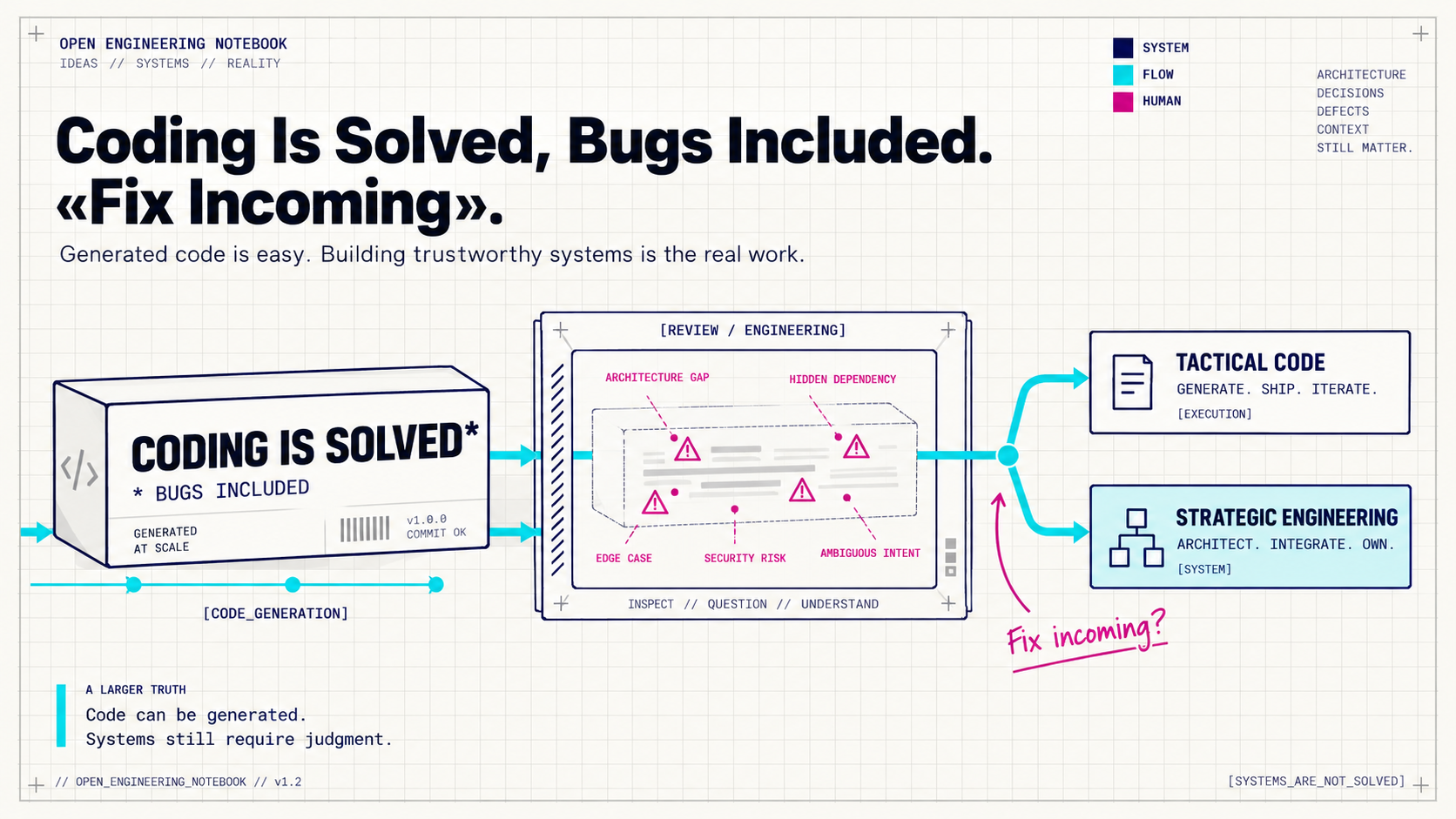
The camp that disagrees with part of Cherny’s claims draws a line between tactical and strategic programming.
Tactical programming is already in the hands of agents: the day-to-day coding, assigned as tasks or following a plan, supervised by humans.
Strategic programming is where agents still don’t get there on their own and where human judgement remains necessary. I covered this in my previous article. It requires architecture, a medium and long-term view, the health and hygiene of the codebase.
For this camp there is no evidence that agents can operate at the strategic level. For Cherny there is, at least with Fable and Opus 5.
And in the AL and Business Central world?
That deserves its own article, and it’s the next one. For me, the meaning is clear: the question is no longer whether you code or not. The questions you need to answer are these. What kind of programming profile do you have, tactical or strategic? How do you perceive yourself? What did you think less than a year ago about AL development with agents? Where are you now? You don’t know? Prompts? Loop? Graph?
In the next article I’ll use my own experience with ALDC and its evolution over just eight months (twelve for me) to bring everything discussed here down to Business Central.
References
Boris Cherny’s original post on X (August 2026)
ALDC – AL Development Collection: github.com/javiarmesto/ALDC-AL-Development-Collection
Previous TechSphere Dynamics article on strategic programming and human judgement
Stay tuned.