

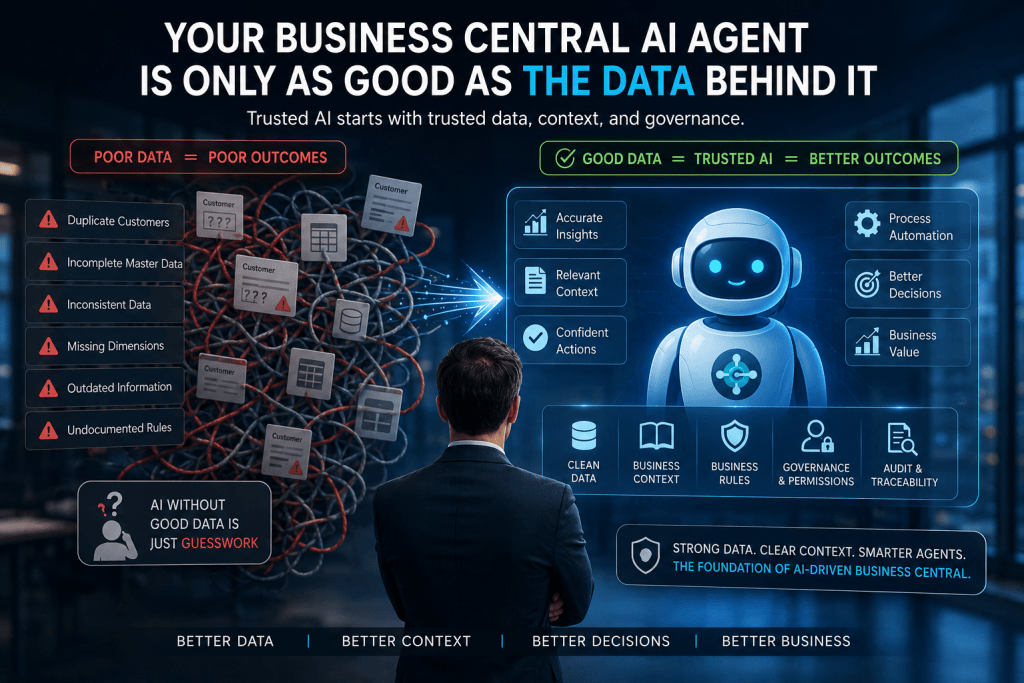

The conversation around AI in Business Central is quickly moving from what AI can do to what AI can be trusted to do. We are seeing AI move beyond answering questions and generating summaries toward agents that can understand business intent, retrieve information, prepare transactions, analyze exceptions, and participate in business processes. That is a significant shift in ERP. But there is an uncomfortable reality that every organization considering AI agents needs to confront: an intelligent agent operating on poor business data is still going to produce poor business outcomes.
In traditional ERP operations, bad data has always been a problem, but humans often compensate for it through experience. A finance user knows that a particular customer is configured differently. A purchasing manager knows which vendor normally delivers late. An experienced Business Central consultant knows why a customization exists even when the documentation does not explain it. People fill the gaps using institutional knowledge accumulated over years.
An AI agent does not automatically have that knowledge.
If the customer master data is incomplete, the agent may select the wrong customer. If item descriptions are inconsistent, it may misunderstand what the user is requesting. If dimensions are poorly maintained, financial analysis can become misleading. If vendor information is outdated, purchasing recommendations may be wrong. If business rules exist only in someone’s memory, the agent cannot reliably apply them.
This creates a fundamental principle for the AI era:
AI does not eliminate ERP data problems. It can amplify them.
Data Quality Is Becoming an AI Capability
For years, organizations treated data quality as an ERP housekeeping exercise. Duplicate customers, incorrect item descriptions, missing dimensions, inconsistent units of measure, obsolete vendors, incomplete master data, and poorly maintained configurations were problems that users and consultants worked around. That mindset has to change.
When humans operate the ERP, poor data creates friction. When AI agents operate within the ERP, poor data can influence decisions at machine speed and scale.
An agent processing one transaction incorrectly is a problem. An agent processing hundreds of transactions using the same incorrect assumption is an architectural risk.
This means organizations should stop asking only whether their Business Central environment is technically ready for AI. They should ask whether their business data is ready to become part of AI-driven decision making.
Business Context Matters More Than the Model
There is also a common misconception that choosing a more powerful AI model will solve the problem. It will not.
The model can reason, but it does not inherently know how your organization operates. It needs access to the right context: Business Central data, business rules, documentation, historical information, policies, customizations, integrations, and organizational knowledge.
This is where technologies such as Retrieval-Augmented Generation become important. RAG can provide agents with relevant enterprise knowledge at the time a decision is being made, but RAG cannot magically fix information that does not exist, is inaccurate, or has never been documented.
An organization with excellent data and business documentation may be able to build a relatively simple agent that performs extremely well. Another organization with years of undocumented customizations and inconsistent master data may struggle even with a highly capable model.
The competitive advantage therefore may not belong to the company with the biggest AI model. It may belong to the company with the best business context.
Your Customizations Are Part of the AI Context
This becomes particularly important in Business Central environments with significant customization. Two companies may both use Business Central, have the same standard tables, and use the same AI technology, yet their agents may need to behave completely differently because their business rules and extensions are different.
A custom field may change how credit limits are interpreted. An extension may introduce a special approval rule. A customization may change how inventory is allocated. An integration may maintain critical information outside Business Central.
If an AI agent does not understand these realities, it may correctly understand the standard Business Central process while still producing an incorrect result for that particular organization.
This is why AI readiness cannot be separated from ERP architecture and documentation. The undocumented knowledge accumulated during years of implementation work is suddenly becoming valuable input for AI.
The New ERP Readiness Question
This changes how leaders should approach AI adoption.
The question should not simply be:
“Which AI agent should we implement?”
A better question is:
“What information would an intelligent employee need to understand our business before we trusted them to perform this process?”
That question immediately exposes the real gaps.
Where is the knowledge stored?
Is the master data reliable?
Are business rules documented?
Are customizations understood?
Can the agent access the required context?
Are permissions clearly defined?
Can its decisions be validated?
Can we trace why it took an action?
These are not exclusively AI questions. They are fundamental ERP governance questions that AI is forcing organizations to address.
The Future Belongs to Context-Rich ERP
The next stage of Business Central will not simply be about connecting agents to more transactions. It will be about giving those agents enough trusted context to make useful decisions while keeping deterministic controls around the actions they perform.
That creates a new architecture:
Business Central data + enterprise knowledge + AI reasoning + deterministic business rules + governance.
The AI provides interpretation and reasoning. Business Central provides the transactional system of record. APIs and tools provide controlled actions. Business rules provide deterministic boundaries. Governance provides accountability.
None of these components can be ignored. The most advanced AI agent connected to unreliable ERP data is not an intelligent enterprise system. It is simply a faster way to make mistakes.
AI Readiness Is ERP Readiness
For leadership teams, this may be the most important lesson.
Before investing heavily in autonomous agents, organizations should invest in the foundations that make autonomy possible: clean master data, reliable transactional history, documented business processes, accessible business knowledge, clear permissions, well-defined rules, and strong ERP governance because the question is no longer whether AI can understand Business Central.
The more important question is whether Business Central contains enough trustworthy information for AI to understand the business.
That is where the real AI transformation begins and perhaps the biggest mistake organizations can make in the AI era is to think they have an AI problem when they actually have a data and business-context problem.