

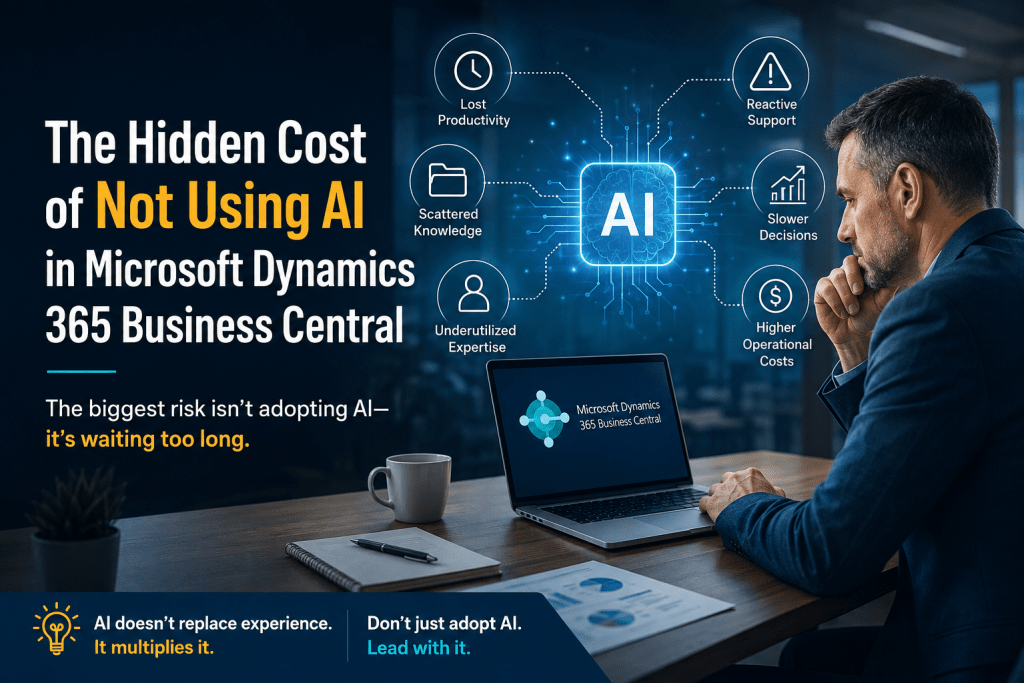

Artificial Intelligence has rapidly become one of the defining topics in the Microsoft Dynamics 365 Business Central ecosystem. Every week brings new announcements, increasingly capable AI models, Copilot enhancements, and AI-powered solutions that promise to transform the way organizations implement, customize, support, and optimize Business Central. Partners are investing in AI, customers are exploring automation, and consultants are beginning to rethink how they deliver projects.
Most conversations naturally focus on the potential return on investment. They discuss productivity gains, automation, and faster delivery. These are important benefits, but I believe they overshadow a much more important business question.
The real question is not “What will AI give us?”
The real question is “What is it costing us to continue working without it?”
After spending the last several months designing AI agents specifically for Microsoft Dynamics 365 Business Central, I have come to realize that the greatest cost of delaying AI adoption rarely appears on a financial report. It is hidden inside repetitive work, fragmented knowledge, slow decision-making, inconsistent project delivery, reactive support, and missed opportunities to use the expertise that already exists within an organization.
These hidden costs accumulate every day. Individually they appear insignificant, but across dozens of consultants, hundreds of support tickets, and multiple implementation projects, they become one of the largest barriers to growth and profitability.
Repetitive Work Is More Expensive Than Most Organizations Realize
Every experienced Business Central consultant has encountered the same situation countless times.
A functional consultant spends hours producing documentation that closely resembles documents created for previous implementations. A developer explains a customization that has already been delivered for another customer. A support consultant investigates an issue that another colleague successfully resolved months ago. A project manager prepares implementation checklists that have been recreated for nearly every project.
None of this work is new. It is simply being repeated because the knowledge already exists but is difficult to discover, organize, and reuse.
For many organizations, this repetition has quietly become part of everyday operations. It is accepted as normal simply because it has always been done that way.
Artificial Intelligence challenges that assumption.
Instead of recreating knowledge every time a similar task appears, AI enables organizations to build upon the experience they have already accumulated. Documentation becomes a starting point rather than a blank page. Support begins with previous resolutions instead of starting every investigation from scratch. Developers can leverage established coding standards and reusable design patterns rather than rediscovering best practices on every project.
The objective is not to eliminate the consultant’s contribution. It is to eliminate unnecessary repetition so consultants can spend their expertise solving new business challenges rather than recreating existing knowledge.
Knowledge Is Becoming the Most Valuable Business Asset
Every successful Business Central implementation generates knowledge. It produces solution designs, architecture decisions, implementation methodologies, coding standards, troubleshooting techniques, testing scenarios, customer-specific configurations, lessons learned, and countless practical experiences that cannot be found in product documentation.
Unfortunately, much of this knowledge remains scattered throughout organizations. Some of it exists inside SharePoint libraries. Some lives in Teams conversations. Some is hidden inside emails. Some remains on personal laptops. Much of it exists only in the minds of experienced consultants.
As organizations grow, this fragmented knowledge becomes increasingly difficult to locate and even more difficult to reuse. The challenge becomes even greater when experienced consultants leave the organization. Years of practical Business Central expertise often disappear with them.
Artificial Intelligence fundamentally changes the value of organizational knowledge. When documentation, implementation standards, support history, reusable solutions, and business processes are structured correctly, they become the foundation upon which AI agents can reason and provide recommendations.
This is why I believe the future competitive advantage will not belong to organizations with access to the latest AI model. It will belong to organizations that have invested in capturing, organizing, and continuously improving their own Business Central knowledge.
AI provides intelligence. Organizational knowledge provides relevance. Together they create something significantly more valuable than either could achieve independently.
Slower Decisions Have a Hidden Financial Impact
Business Central projects are driven by decisions. Every implementation requires consultants to evaluate business processes, compare different solution approaches, review previous implementations, assess technical risks, validate customizations, and determine how standard functionality should be applied.
Experienced consultants naturally perform these activities by drawing upon years of accumulated knowledge. However, finding the right information often consumes far more time than making the decision itself.
Consultants search previous projects, review documentation, contact colleagues, examine historical support cases, and investigate similar customer requirements before they can confidently recommend the next step. Artificial Intelligence dramatically reduces this effort.
Rather than replacing professional judgment, AI accelerates the discovery of relevant information, enabling consultants to begin with insight instead of searching for it. Customers benefit from faster responses, better consistency, and more informed recommendations. Consultants spend less time collecting information and more time applying their expertise where it delivers the greatest value.
Reactive Support Is No Longer Sustainable
For decades, Business Central support has followed a familiar pattern.
A user encounters a problem.
A support ticket is created.
The support team begins investigating.
Logs are reviewed, configurations are checked, users are contacted, and possible causes are analyzed.
Eventually, a solution is identified, implemented, and validated.
Only then does the organization recover from the issue. This reactive model has served the ERP industry for many years, but it was designed for a time when systems could only respond after something had already gone wrong.
Artificial Intelligence changes that assumption.
Instead of waiting for users to report problems, AI can continuously observe the operational health of a Business Central environment, analyze transactional patterns, monitor system behaviour, and identify risks long before they become business-critical incidents.
Imagine AI recognizing that a customer is approaching their credit limit before the next sales order is entered. Imagine inventory shortages being identified days before they begin affecting production or customer deliveries. Imagine AI detecting missing posting setups, unusual posting behaviour, approval workflow bottlenecks, integration failures, or deteriorating system performance before users experience the consequences.
It can also identify trends that are often difficult for support teams to detect manually. A gradual increase in posting errors, recurring synchronization failures between integrated systems, an unusual growth in blocked documents, or a sudden increase in long-running background jobs may not seem significant in isolation. However, when viewed together, these patterns often indicate a much larger operational issue developing beneath the surface.
Rather than waiting for a business disruption to occur, AI enables organizations to intervene while the problem is still manageable. This represents a fundamental shift in the way Business Central support is delivered. Support teams move from spending most of their time responding to incidents toward continuously improving system health, preventing recurring issues, and helping customers operate more efficiently.
The objective is not to replace experienced support consultants. Their expertise remains essential for understanding business processes, validating recommendations, and resolving complex scenarios that require human judgment.
Instead, AI becomes another member of the support team—continuously monitoring the environment, surfacing anomalies, prioritizing risks, and providing consultants with the information they need before customers even realize something is wrong. Organizations that embrace this proactive approach won’t simply resolve support tickets faster. They will reduce the number of incidents altogether, improve system reliability, increase customer confidence, and allow their support teams to focus on delivering strategic value instead of constantly fighting operational fires.
Consultant Expertise Should Be Invested Where It Creates the Greatest Value
One of the most overlooked costs of delaying AI adoption is how experienced Business Central consultants spend their time.
Business Central consultants accumulate their expertise over many years of implementations, upgrades, support engagements, and customer interactions. They learn how businesses operate, recognize risks before they become issues, understand the trade-offs between standard functionality and customization, and guide customers through complex business decisions. That experience is one of the most valuable assets any Business Central partner possesses.
Yet, despite this expertise, many consultants continue to spend a significant portion of their day creating documentation, preparing UAT scenarios, summarizing workshops, searching previous project files, reviewing repetitive code, responding to similar support questions, and recreating deliverables that have already been produced countless times.
These activities are essential to every implementation, but they are rarely where consultants create their greatest value. Artificial Intelligence offers an opportunity to fundamentally change this balance. By automating repetitive and time-consuming activities, AI allows consultants to focus on the work that customers genuinely value—understanding business objectives, solving operational challenges, designing scalable solutions, advising stakeholders, identifying risks, and driving successful business transformation.
Instead of beginning every project with a blank document, consultants can begin with an AI-generated draft built from previous implementations. Instead of manually preparing UAT scripts, they can review and refine scenarios tailored to the customer’s processes. Instead of searching through years of project documentation, AI can surface relevant knowledge within seconds. Rather than spending valuable hours organizing information, consultants can invest that time applying their judgment, creativity, and business expertise.
This shift is far more significant than simply improving productivity. It changes the role of the consultant from someone who primarily produces deliverables to someone who delivers strategic business value.
As this transformation accelerates, the definition of competitive advantage within the Business Central ecosystem is also changing. For many years, organizations differentiated themselves through technical expertise, implementation experience, and their ability to successfully deliver Business Central projects. Those capabilities remain critically important, but they will no longer be sufficient on their own.
In the near future, every Business Central partner will have access to powerful AI models. Every consultant will be able to generate documentation, summarize meetings, review code, and automate routine activities. These capabilities will gradually become standard rather than exceptional.
What will separate successful organizations from everyone else will not be access to Artificial Intelligence itself. It will be how effectively they integrate AI into their consulting methodology, how well they capture and reuse organizational knowledge, how they govern AI responsibly, and how they design specialized AI agents that consistently support consultants throughout the entire implementation lifecycle.
The most successful Business Central partners will not simply use AI to work faster. They will redesign the way they deliver projects, preserve organizational knowledge, improve quality, reduce repetitive effort, and enable every consultant to benefit from the collective experience of the entire organization.
Ultimately, AI will not diminish the value of experienced Business Central consultants. It will amplify it. The firms that recognize this shift early will not compete by having more consultants. They will compete by enabling every consultant to achieve significantly more than was previously possible, combining years of human expertise with the speed, consistency, and scalability that Artificial Intelligence brings to every project.
Finally Building AI agents for Microsoft Dynamics 365 Business Central has taught me one important lesson: the biggest cost isn’t adopting AI—it’s delaying the transformation it makes possible. Every month spent relying on traditional ways of working means more duplicated effort, slower delivery, reactive support, and valuable organizational knowledge left untapped.
AI isn’t replacing Business Central consultants. It’s enabling them to scale their expertise, make better decisions, and deliver greater value to every customer. The partners who succeed over the next decade won’t simply use AI to work faster. They’ll use it to work smarter by combining human expertise with organizational knowledge and intelligent automation because ultimately, the hidden cost of not using AI isn’t measured in technology investments. It’s measured in the opportunities your organization never realized while others redefined the future of Microsoft Dynamics 365 Business Central.