


For decades, enterprise resource planning systems have been built around a simple operating model: people learn the software, navigate its screens, understand its processes, enter information, and ultimately tell the system what needs to happen. Microsoft Dynamics 365 Business Central is no different in that respect. Whether the user is creating a sales order, reviewing an overdue invoice, investigating an inventory issue, correcting a posting error, or analyzing financial information, the ERP has traditionally been the place where people execute business processes through structured screens, predefined workflows, reports, and transactions. Over the last few years, however, something fundamental has started to change. Artificial intelligence is not simply becoming another feature inside the ERP; it is beginning to change the relationship between people and the ERP itself. The evolution from traditional ERP interfaces to Copilot and now toward AI agents represents a much larger transformation than conversational interaction. It represents a movement from software that waits for users to operate it toward software that can increasingly understand intent, reason over business context, perform work, monitor operations, and involve people when decisions require human judgment.
The first major change was the move from traditional navigation toward conversational assistance. For years, ERP users were expected to understand where information existed within the application and which sequence of pages and actions was required to accomplish a task. The introduction of Copilot-style experiences changed that expectation because users could begin expressing what they wanted in natural language rather than translating their business requirement into a sequence of application commands. Instead of thinking about which page to open or which filter to apply, a user could ask a question about customers, sales, inventory, or other business information and receive assistance directly from the system. This is an important change because it reduces the distance between business intent and software interaction. However, conversational assistance is only the beginning of the transformation. A system that can answer a question is useful, but an enterprise system that can understand an objective, gather the required information, determine what needs to happen, carry out multiple steps, validate the outcome, and escalate exceptions represents an entirely different category of capability.
This is where the concept of the AI agent becomes important. An AI assistant primarily responds to a request, while an agent is designed around achieving an objective. The difference may appear subtle, but from an ERP architecture perspective it is significant. Consider a user asking why a sales transaction failed to post. A conventional system provides an error message, and an AI assistant can potentially explain what that error means. An agent can take the problem further by investigating the transaction, examining relevant customer or item information, evaluating posting configuration, looking at related business rules, identifying possible causes, and presenting a recommended resolution. The value is no longer simply in generating an explanation; it comes from coordinating multiple pieces of information and reasoning about the business context surrounding the transaction. This is the point at which AI starts moving from an interface technology toward an operational technology.
The Emergence of the AI Agent Stack
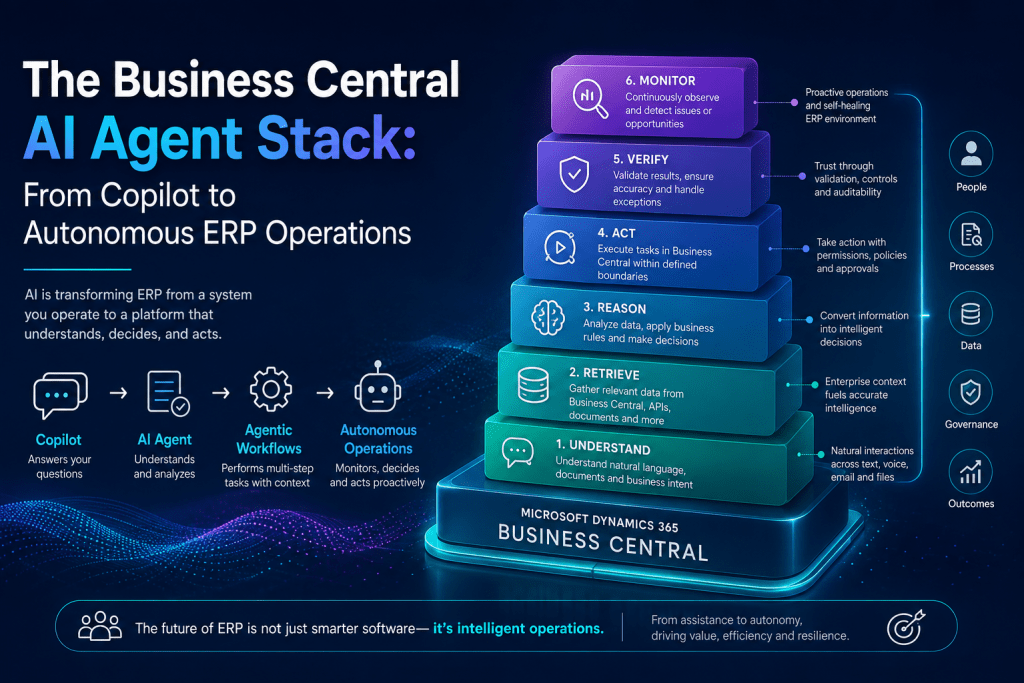
The evolution of AI within Business Central can therefore be viewed as a stack rather than as a single capability. At the foundation is the ability to understand business intent, whether that intent arrives through natural language, documents, structured data, or other forms of interaction. Above that sits the ability to retrieve the information required to understand the situation, potentially combining Business Central data with documentation, organizational knowledge, policies, historical transactions, and information from other systems. The next layer is reasoning, where the agent evaluates that information and determines what it means in the context of the business process. The following layer is action, where the agent can prepare or execute an operation through appropriate tools and interfaces. Verification then becomes essential because an agent must be able to determine whether the action actually succeeded rather than simply assuming that it did. Finally, monitoring allows agents to continuously observe the environment and identify problems or opportunities without waiting for a user to initiate a request.
This progression can be described as Understand, Retrieve, Reason, Act, Verify, and Monitor. It is important because it demonstrates why the conversation around AI in ERP should not stop at Copilot. Copilot addresses an important part of the first layer, but enterprise AI innovation becomes considerably more interesting when these capabilities are connected into a controlled operational model. A user might initially ask the system for information, then ask it to analyze that information, then ask it to recommend an action, and eventually allow it to prepare or execute that action. At the same time, the system can begin monitoring the environment continuously rather than waiting for someone to discover an issue. The result is a progression from AI that responds to users toward AI that participates in business operations.
From Asking Questions to Delegating Work
One of the clearest indicators of this change is the shift in the nature of the requests users can make. In a traditional ERP environment, the user might ask, “Where can I find the overdue customer invoices?” The answer is a page, report, or query. With conversational AI, the question becomes easier because the user can simply ask the system to provide the information. With an agent, the request can become substantially more sophisticated: “Identify the customers with the highest overdue exposure, consider their payment history and current open orders, and prepare a prioritized collection list for the finance team.” The difference is not simply that the second request contains more words. The difference is that the user is expressing an objective rather than instructing the software how to retrieve a particular piece of information.
This distinction is likely to become one of the most important changes in enterprise software. Business users generally think in terms of outcomes, while traditional software has required them to think in terms of processes and screens. AI agents create the possibility of moving the interface closer to the way people actually think about work. A sales manager does not fundamentally think, “I need to open this page, apply this filter, select these records, export this report, and then analyze it.” The actual business objective is, “I need to understand which customers require attention.” When software becomes capable of interpreting that objective and coordinating the necessary steps, the ERP begins to behave less like a collection of screens and more like an operational platform.
From Recommendation to Action
The next major change occurs when AI moves from recommendation toward action. Consider a simple sales process in which a customer sends a request containing products and quantities. Traditionally, someone reads the request, identifies the customer, finds the relevant items, creates the sales order, enters quantities, checks pricing and other relevant information, and then reviews the transaction before posting it. An AI agent can potentially interpret the original request, identify the corresponding records in Business Central, prepare the transaction, validate the information, and present a completed draft for human review.
This illustrates an important principle for enterprise AI: automation does not necessarily mean removing the human from the process. In many ERP scenarios, the most valuable model will initially be one in which AI removes repetitive operational work while humans retain responsibility for judgment and authorization. The agent can prepare the transaction, but the appropriate user can review and approve it before the system performs a consequential action. Over time, some low-risk activities may become fully automated while higher-risk activities continue to require approval. The result is not an ERP without humans; it is an ERP in which human attention is concentrated where it creates the most value.
This creates a spectrum of autonomy rather than a binary choice between manual processing and fully autonomous software. At one end, AI can provide information and recommendations. Further along the spectrum, AI can prepare transactions and workflows for approval. Beyond that, agents can execute predefined actions within clearly defined boundaries. Eventually, certain processes can become continuously monitored and partially autonomous, with humans becoming responsible for exceptions, policy decisions, and high-impact approvals. The appropriate level of autonomy will depend on the financial, operational, regulatory, and business risk associated with the activity.
Why One Giant AI Agent Is Not the Answer
As organizations begin experimenting with agents, there is a natural temptation to imagine one highly capable AI system with access to the entire ERP. In practice, that may not be the most effective or safest architecture. Business Central contains multiple functional domains, each with different data, processes, permissions, business rules, and risk profiles. Finance, sales, purchasing, inventory, warehouse operations, manufacturing, integrations, master data, and technical operations all represent different problem spaces.
A more practical architecture is likely to involve specialized agents with clearly defined responsibilities. A transaction agent might focus on preparing and validating business transactions, while a finance agent focuses on financial analysis and exceptions. A support agent could investigate operational errors, a data agent could identify master-data quality problems, a development-oriented agent could analyze extensions and code, and an operations agent could monitor system health and performance. These agents do not necessarily need to operate independently; they can work as a coordinated ecosystem in which one agent can request information or assistance from another while maintaining clear boundaries around what each component is permitted to do.
This introduces an important concept for enterprise AI architecture: specialization may be more valuable than unlimited intelligence. A focused agent with the right context, tools, permissions, and validation mechanisms can potentially deliver more reliable business outcomes than a general-purpose agent with broad unrestricted access. The objective should not be to create the largest possible AI system. The objective should be to create an architecture in which each agent has enough intelligence to perform its responsibility and enough constraints to operate safely.
The Importance of Business Context
Large language models are powerful, but general intelligence is not the same as enterprise knowledge. An AI agent operating in Business Central needs access to the specific context of the organization in which it operates. That context can include master data, transaction history, customizations, extensions, internal procedures, approval policies, industry-specific requirements, integration behavior, and historical support knowledge.
This is where technologies such as Retrieval Augmented Generation become important. Instead of expecting the model to have all relevant information within its training, an agent can retrieve the information it needs at the time it is performing a task. The agent might combine Business Central data with organizational documentation and policy information before making a recommendation. This creates a much more grounded interaction because the agent is reasoning over the actual environment rather than relying exclusively on generalized knowledge.
The broader implication is that successful enterprise AI will increasingly depend on context architecture as much as model intelligence. Organizations that have poor data quality, fragmented documentation, unclear business rules, or inconsistent processes will face challenges regardless of how capable the underlying AI model becomes. AI does not remove the need for good enterprise foundations; in many cases, it makes those foundations even more important.
Autonomous Operations Are the Next Frontier
The most significant opportunity may not actually be transactional automation. It may be continuous operational intelligence.
Traditional ERP support is often reactive. A user experiences a problem, reports it, and someone begins investigating. A job queue fails, a process becomes slow, a transaction cannot be posted, or users experience locking, and the problem becomes visible only after it affects someone.
AI agents introduce the possibility of changing that model. An operations agent could continuously examine signals from the ERP environment and identify unusual behavior before it becomes a significant business disruption. It could look for recurring errors, failed background processes, performance anomalies, unusual transaction behavior, integration failures, or other operational patterns. Instead of waiting for someone to say that Business Central has become slow, the system could identify that a particular process is behaving outside its expected baseline and bring the issue to the attention of the appropriate person.
This is a fundamental change in ERP operations because the system becomes capable of observing itself. The transition is therefore not simply from manual work to automated work; it is from reactive ERP operations to proactive ERP operations. Once monitoring, reasoning, and controlled action are connected, the ERP can potentially move from detecting a problem to recommending a resolution and, for appropriately low-risk scenarios, initiating corrective action automatically.
Governance Will Determine How Far Autonomy Can Go
The more capable AI agents become, the more important governance becomes. Giving an agent the ability to read information is fundamentally different from giving it the ability to change information, and changing information is fundamentally different from allowing it to execute financially or operationally significant transactions. The architecture therefore needs to establish clear boundaries around what an agent can see, what it can modify, what it can execute, and when human authorization is required.
Traditional application security provides an important foundation, but agent-based systems introduce additional questions. What information did the agent retrieve before making its decision? Which tools did it use? What action did it attempt? Which business rules were applied? Who approved the action? What changed in Business Central? Did the operation succeed? What happened afterward? These questions become essential when AI moves from providing information to taking action.
This is why agent observability and governance will become as important as application observability and governance. An organization should be able to reconstruct what happened when an AI agent performs an important business operation. Without that transparency, autonomous ERP can quickly become a black box, which is difficult to audit, difficult to troubleshoot, and difficult for business leaders to trust.
Probabilistic Intelligence Needs Deterministic Controls
There is a fundamental architectural tension in AI powered ERP systems. Large language models are probabilistic systems, while ERP transactions often require deterministic outcomes. A model may be highly capable of interpreting language and reasoning over complex information, but financial posting, inventory movements, customer balances, and other transactional operations must follow precise business rules.
The solution is not to eliminate AI from these processes. It is to place deterministic controls around probabilistic intelligence.
An agent can interpret the user’s intent, gather context, reason about possible actions, and propose a transaction, while Business Central and the surrounding control framework enforce permissions, validations, posting rules, approval requirements, and transaction constraints. AI determines what it believes should happen; deterministic enterprise systems determine whether that action is allowed to happen.
This distinction may become one of the defining principles of enterprise agent architecture:
Use probabilistic intelligence for understanding and reasoning, and deterministic controls for execution and governance.
That model provides a path toward meaningful automation without treating AI as an unrestricted authority over the ERP.
The New Role of the ERP User
If this evolution continues, the role of the ERP user will change significantly. The user of the future may spend less time entering repetitive information, searching through pages, running standard investigations, and manually monitoring routine operational conditions. Instead, the user will increasingly define objectives, review recommendations, approve high-impact decisions, manage exceptions, and supervise the behavior of intelligent systems.
This does not mean ERP expertise becomes less important. In fact, it may become more important because someone must understand the business processes, controls, risks, and consequences behind the agent’s actions. The nature of expertise changes from knowing every step required to execute a process toward understanding how the process should operate and how intelligent systems should be governed around it.
The same transformation will occur for ERP consultants and architects. Their role will increasingly extend beyond configuration and customization into areas such as agent architecture, integration strategy, AI governance, business-process redesign, security, observability, and human-in-the-loop design. The most valuable skill may no longer be simply knowing how to make the ERP perform a task; it may be knowing which tasks should be automated, which should remain human-controlled, and how to create the architecture that safely connects the two.
From ERP Automation to Agentic ERP
Traditional ERP automation generally follows predefined rules. If condition A occurs, perform action B. This model is extremely valuable for predictable processes, but it becomes difficult when the input is unstructured or when the required response depends on context.
AI agents introduce a different model. They can interpret a business objective, retrieve information, reason over that information, select tools, perform multiple steps, and adapt their behavior based on what they discover. This creates the possibility of automating processes that were previously considered too variable or knowledge-intensive for conventional workflow automation.
The distinction is important because the next generation of ERP automation is unlikely to replace traditional automation. Instead, AI agents will sit alongside workflows, APIs, business rules, extensions, integrations, and existing automation technologies. Deterministic workflows will continue to handle processes that are predictable and well-defined, while AI agents will increasingly handle situations where interpretation, reasoning, and context are required.
The resulting architecture is therefore not AI replacing ERP automation. It is AI expanding the boundary of what can be automated.
What Autonomous ERP Really Means
The phrase “autonomous ERP” can easily create unrealistic expectations. It does not necessarily mean an ERP system operating without people, and it certainly does not mean handing unrestricted control of business operations to an AI model.
A more realistic definition is an ERP environment in which intelligent agents can continuously understand business context, identify opportunities and problems, recommend actions, prepare transactions, execute appropriately authorized activities, verify outcomes, and escalate exceptions to humans.
Under this definition, autonomy becomes a controlled capability rather than an absolute state.
A low-risk activity may be fully automated. A medium-risk activity may be prepared by AI and approved by a person. A high-risk financial or operational activity may always require explicit authorization. The level of autonomy can therefore be aligned with the consequences of failure.
This is likely to be much more useful for enterprises than the idea of completely autonomous software.
The Leadership Question Is Bigger Than Technology
For business leaders, the most important question is not which AI model should be selected or which new AI feature should be enabled. Those questions matter, but they are implementation decisions within a much larger transformation.
The strategic question is:
Which parts of our business processes should no longer require humans to perform repetitive operational work?
That question forces organizations to look beyond individual AI features and examine the entire operating model. It requires understanding where people spend time, where decisions are repetitive, where exceptions occur, where data is available, where risks are concentrated, and where human judgment genuinely adds value.
The organizations that benefit most from AI in ERP will probably not be the organizations that simply deploy the most AI features. They will be the organizations that redesign processes around the capabilities AI makes possible while maintaining strong controls around the activities that require accountability.
The Road Ahead
The transition from traditional ERP to agentic ERP is unlikely to happen through one dramatic release. It will happen incrementally. First, users will ask more questions instead of navigating. Then AI will perform more analysis instead of simply retrieving information. Agents will begin preparing transactions and workflows. Some low-risk actions will become automated. Monitoring will become increasingly intelligent. Specialized agents will begin working together. Over time, the boundary between software automation and AI-driven operations will become increasingly difficult to distinguish.
The screens of Business Central may not look dramatically different during this transformation. The deeper change will happen underneath the interface.
Today, the user generally operates the ERP.
With Copilot, the user increasingly communicates with the ERP.
With agents, the user delegates work to the ERP.
With autonomous operations, the ERP increasingly identifies what requires attention and brings the right decisions to the right people.
That is the real significance of the AI agent stack.
The future of Business Central is not simply about putting more intelligence into the interface. It is about creating an intelligent operational layer that can understand business intent, reason over enterprise context, perform controlled actions, verify outcomes, and continuously monitor the environment.
The technology will continue to evolve, but the leadership challenge is already clear: organizations need to decide where they want AI to assist, where they want it to act, where they want humans to remain firmly in control, and what governance will be required as that boundary moves. The most important transformation may therefore not be that AI learns how to use Business Central.
It may be that Business Central becomes capable of participating in the way the business itself operates.