


Over the past two decades, I’ve had the privilege of witnessing the remarkable evolution of Microsoft Dynamics NAV into Microsoft Dynamics 365 Business Central. Looking back, every major technological shift has changed not only the platform but also the role of the consultant. We transitioned from on-premises deployments to cloud ERP, embraced extensions instead of customizations, adopted APIs, Power Platform, DevOps, and continuous delivery, and learned to deliver projects in ways that would have seemed impossible years ago. Every change required us to adapt, learn new skills, and rethink the way we delivered value to our customers.
Interestingly, every one of these transformations came with the same concern: “Will consultants still be needed?” Yet history has shown that technology has never reduced the importance of great consultants it has simply changed where they create value. As repetitive technical tasks became easier, customers expected more from us. They no longer looked to consultants merely to configure Business Central or write code. They expected strategic advice, stronger governance, better documentation, higher-quality implementations, and solutions that delivered measurable business outcomes. The consultant’s role didn’t disappear; it became more valuable.
Today, our profession stands at what I believe is the biggest transformation yet Artificial Intelligence. Every day we see new AI models, copilots, and agentic AI platforms capable of writing code, generating documentation, reviewing solutions, and answering complex questions. Naturally, the conversation often turns to a familiar question: “Will AI replace Business Central consultants?”
Personally, I believe we’re asking the wrong question.
The real question isn’t whether AI will replace us. The real question is what the Business Central consultant of 2030 will look like. What skills will define the next generation of consultants? How will AI reshape project delivery? And where will human expertise create the greatest value?
Over the past several months, while designing AI solutions specifically for Microsoft Dynamics 365 Business Central—from Documentation Agents and Code Review Agents to UAT Agents, Troubleshooting Assistants, AI Knowledge Hubs, and AI Maturity Frameworks I have spent a great deal of time thinking about those questions.
The conclusion I’ve reached is both exciting and reassuring.
AI isn’t replacing Business Central consultants. It is redefining what great consultants spend their time doing.
I believe the consultants who embrace this shift won’t simply adapt to the future they will lead it.
The Business Central Consultant of 2030
One of the biggest misconceptions about Business Central consulting is that our value lies in configuring the system, writing AL code, or delivering implementations. While those skills are important, they have never been what truly differentiates an experienced consultant. The real value has always been judgment the ability to ask the right questions, identify risks before they become issues, understand how business processes interact, balance standard functionality with customization, and recommend solutions that align with long-term business goals. These are capabilities developed through years of project experience, not by simply reading documentation or learning a new feature.
That is exactly why I don’t believe AI will replace great consultants. Instead, it will amplify their expertise by removing much of the repetitive work that consumes valuable time today.
Imagine starting a Business Central implementation in 2030. Before the first discovery workshop even begins, specialized AI agents have already analyzed the customer’s existing environment, summarized business processes, identified risks from similar implementations, prepared an initial functional specification, generated UAT scenarios, and suggested potential solution approaches. Instead of beginning with a blank document, the consultant begins with meaningful insights. Rather than spending days collecting information and creating deliverables, they focus on validating assumptions, challenging ideas, collaborating with stakeholders, and designing solutions that create real business value.
I believe this is the biggest shift AI will bring to Business Central consulting. The consultant’s role won’t become less important it will become more strategic. AI will accelerate preparation, but human expertise, judgment, and customer engagement will remain at the center of every successful implementation.
The Rise of AI-Powered Consulting
If we’re honest, a significant portion of today’s Business Central consulting is spent on repetitive activities. We invest countless hours creating documentation, preparing UAT scenarios, reviewing code, writing meeting summaries, searching previous projects, finding known solutions, producing training material, and continuously updating project documentation. These activities are essential to every successful implementation, but they are not where consultants create their greatest value. Their true value lies in understanding customer challenges, making sound business decisions, solving complex problems, and guiding organizations through change.
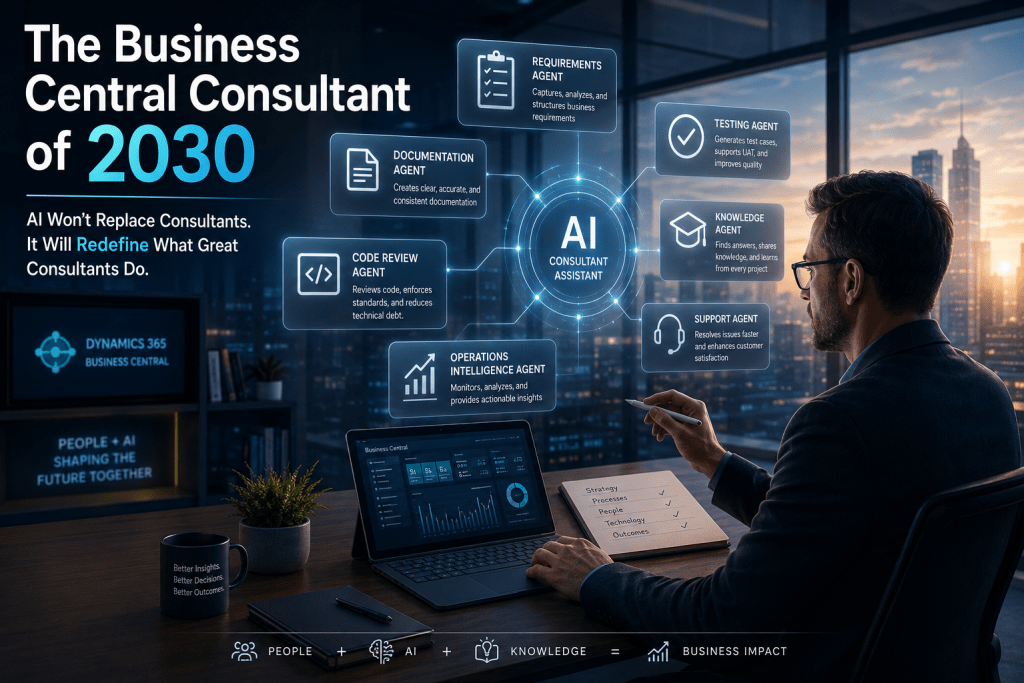
This is where AI has the potential to transform our profession. Rather than replacing consultants, AI can take ownership of much of the repetitive work that supports an implementation, allowing consultants to focus on the activities that require experience, creativity, and business judgment. I no longer think of AI as another software application; I think of it as another member of the project team. Just as today’s implementations involve architects, developers, functional consultants, testers, and project managers, tomorrow’s implementations will include specialized AI team members responsible for documentation, requirements analysis, code reviews, testing, knowledge retrieval, operational insights, and support. Each AI agent will have a clearly defined responsibility, access to the right knowledge, and continuously improve as it learns from previous projects. The consultant’s role won’t be to compete with these AI specialists, but to orchestrate them, validate their recommendations, and ensure they deliver meaningful business outcomes.
This evolution also changes what I believe will become the greatest competitive advantage for every Business Central partner organizational knowledge. Every implementation generates valuable experience in the form of business processes, solution designs, coding standards, support resolutions, testing scenarios, training materials, and lessons learned. Today, much of that knowledge remains scattered across SharePoint sites, Teams conversations, emails, repositories, and personal notebooks. In the AI era, that information becomes far more valuable than documentation alone. It becomes the knowledge foundation that trains every AI agent and enables it to deliver recommendations that reflect the organization’s own experience and best practices. The organizations that systematically capture, structure, and continuously enrich this knowledge won’t simply build better documentation—they’ll build smarter AI, stronger consulting practices, and a lasting competitive advantage.
The Consultant Becomes an AI Orchestrator
I don’t believe the Business Central consultant of the future will spend less time learning—quite the opposite. The difference is that the skills defining great consultants will evolve. While technical expertise will remain important, business process consulting, communication, critical thinking, and decision-making will become even more valuable. Consultants will need to understand how to design AI-driven workflows, govern AI responsibly, validate AI recommendations, and integrate specialized AI agents into every stage of an implementation. The ability to combine deep Business Central expertise with AI capabilities will become one of the profession’s greatest differentiators.
Throughout my own AI journey, one lesson has consistently stood out: trust matters more than intelligence. An AI assistant that occasionally produces brilliant answers but frequently makes assumptions will never become part of a consultant’s daily workflow. Consultants need AI that reasons consistently, understands its boundaries, follows structured processes, and knows when to ask for more information instead of confidently generating the wrong answer. In the future, the most successful consultants won’t be the ones using the smartest AI they’ll be the ones working with AI they can trust.
Perhaps the biggest transformation, however, won’t be technical at all. It will be managerial. The Business Central consultant of 2030 won’t simply perform every task themselves; they will orchestrate work across both people and specialized AI agents. They will assign responsibilities, review AI-generated outputs, validate recommendations, combine insights from multiple AI specialists, and make the final business decisions. In many ways, consultants will become leaders of hybrid project teams where human expertise and AI collaborate seamlessly. I believe this new consulting model will define the next generation of successful Business Central implementations.
Looking Ahead
When people ask me where AI is taking Microsoft Dynamics 365 Business Central, my answer is surprisingly simple. I don’t believe AI will reduce the need for great consultants. I believe it will raise the standard of what great consulting looks like.
The Business Central consultant of 2030 won’t be measured by how much documentation they write, how many hours they spend configuring the system, or how quickly they can complete repetitive tasks. Those activities will increasingly be supported by specialized AI agents. Instead, consultants will be valued for what has always mattered most—their ability to understand businesses, solve complex problems, make sound decisions, build trusted customer relationships, and guide organizations through change. AI will amplify those strengths, allowing consultants to spend less time producing deliverables and more time creating meaningful business outcomes.
The firms that succeed won’t simply invest in the latest Large Language Models or the newest AI platform. They will build something far more valuable: a culture where people, organizational knowledge, and AI work together seamlessly. They’ll capture experience instead of losing it, design AI with clear responsibilities instead of generic capabilities, and create consulting practices where every project makes both their people and their AI smarter.
I believe every Business Central consultant will eventually have a digital team working alongside them specialized AI agents that prepare documentation, review code, generate test scenarios, retrieve organizational knowledge, monitor operations, and surface business insights before problems arise. The consultant won’t be replaced by these AI team members; they will lead them, validate their recommendations, and transform them into better decisions for customers.
Looking back over the last twenty years, every major technological shift has expanded the opportunities for consultants who chose to embrace change rather than resist it. I believe Artificial Intelligence will be no different. In fact, it may become the greatest opportunity our profession has ever seen.
The future of Business Central consulting isn’t about people versus AI. It’s about people empowered by AI and I truly believe that the consultants who start building that future today won’t simply adapt to the next decade they’ll define it.