
You’ve done it. You’ve successfully navigated the daunting journey from a blank piece of paper to a smooth Go-Live. But here’s the truth I share with every Customer Service Director and Housing Leader: Go-Live is just the starting point.
To ensure a lasting return on your investment, we must enter Phase 5: Continuous Improvement (The final one of the 5 phases). This step will stop your new system from becoming tomorrow’s rigid, expensive, and outdated one. This final phase is crucial. It is designed to leverage agility and cost reduction. This approach guarantees your CRM system continues to evolve.
This is where my 20-plus years of experience in social housing operations and implementing CRM systems comes into play. My focus is on delivering precise, proven, actionable plans that ensure your investment delivers measurable outcomes: empowerment for your team and fund liberation for building new homes.
Here how to keep up that momentum, structured for both housing leaders and the IT teams who maintain the system.

1. The Power of Marginal Gains (For Housing Leaders)
After launch, many organisations instinctively look for the “next big project.” But the most effective strategy for long-term user satisfaction is focusing on continuous, small-scale improvements.
Sir Dave Brailsford’s approach in British Cycling—accumulating small, marginal gains—illustrates the power of this strategy. In the housing sector, this looks like refining small details based on real user feedback:
- Refining the Workflow: It could be as simple as moving a key field on a form to provide a better user experience, or adjusting a workflow to ensure a Service Level Agreement (SLA) is met automatically.
- Preventing User Fatigue: These continuous, small changes prevent user fatigue and system stagnation, which often results from large, disruptive updates.
- Focusing on Fundamentals: A colleague once highlighted something in our discussions. It’s about restricting new data capture to the “fundamental data” needed for the process. For example, continuing to limit the fields captured in the new housing application and utilising quick links. Enabling teams to view more detailed property information in the Housing Management System (HMS), and preventing screen overload.
These constant tweaks demonstrate to your team that their new system is actively adapting to their needs, rather than them having to adapt to a rigid tool.
2. Building for the Future: Embracing Low-Code/No-Code (LCNC)
A core promise of the Microsoft Power Platform is its low-code/no-code (LCNC) capability. Leveraging this capability is paramount for IT teams and essential for maximizing long-term investment.
For IT Teams: Sustaining Agility and Reducing Cost
LCNC capabilities, often available in-house, are critical for reducing costs and delivering a better customer experience, as these solutions fit into the longer-term CRM Roadmap.
- Internal Capability: You should aim to use LCNC tools to enable your internal teams to deliver more changes autonomously. By focusing on configuration rather than custom code, the system becomes easier for your team to understand and manage, enabling them to train new starters themselves.
- The Governance Check: While LCNC is compelling, it carries risks, such as the ‘Wild West’ phenomenon, where various departments build disparate, unmanaged apps, creating data silos. We mitigate this by establishing a team of champions who feed ideas to the IT team for structured implementation.
- Ownership and Control (The Pitch): When working with me, every aspect of the solution is designed so that you own all the entities created. This is a critical differentiator: full ownership of the intellectual property means no hidden subscriptions (beyond the Microsoft licenses), and it protects you from potential supplier lock-down, as noted by colleagues discussing external contractor risks.
The Cultural Shift: Empowering Users
LCNC changes who drives innovation. Priya Javeri, Chief Information Officer at A2Dominion Housing, highlighted this cultural shift: “You no longer need to be a programmer to write a bot,” explaining that staff outside IT can now build their own digital tools, meaning people closer to the problem can now drive innovation. Your training programs should embrace this adaptability.
3. Structuring Future Development: The Living Roadmap
Implementation is a starting point, but the system must continue to evolve. Structuring future changes requires discipline and alignment with strategic goals.
Addressing Business Pain Points
Senior managers must be engaged to identify existing business challenges that the CRM could alleviate, thereby securing resources for development. This ensures development focus remains strategic and tied to organizational needs. As Alison McKenzie-Folan (Wigan Council) noted, focusing on transformation means viewing it as an investment in long-term outcomes rather than short-term cuts.
The Evolving CRM Road Map
The original CRM Road Map developed in Phase 1 (Strategy, Purpose, and Foundation) must be treated as a live document.
- Horizon Scanning: The Road Map must include continuous improvements and link back to your strategic purpose. It should also incorporate horizon scanning for new technologies or functionality to maintain a competitive edge.
- Communication: Add continuous improvements to the CRM Road Map and communicate it widely so everyone knows what’s on the horizon. This disciplined approach is how IT teams structure future changes, ensuring every development decision relates back to a defined strategic element (e.g., improving customer service).
Reclaim Your Mission: The Final Pitch
Many housing associations remain trapped by systems that actively prevent colleagues from providing excellent service and divert critical funds away from building new homes.
By committing to Phase 5: Continuous Improvement, you ensure that your CRM system is always working smarter, leading to:
- Empowerment: Your team is empowered to provide excellent service with intuitive tools.
- Cost savings and efficiencies are realised, ensuring funds are freed up and can be reinvested into building new homes and communities.
If you are ready to ensure your CRM investment pays dividends year after year, let’s discuss how to embed this continuous improvement model to deliver great customer service and remain compliant.
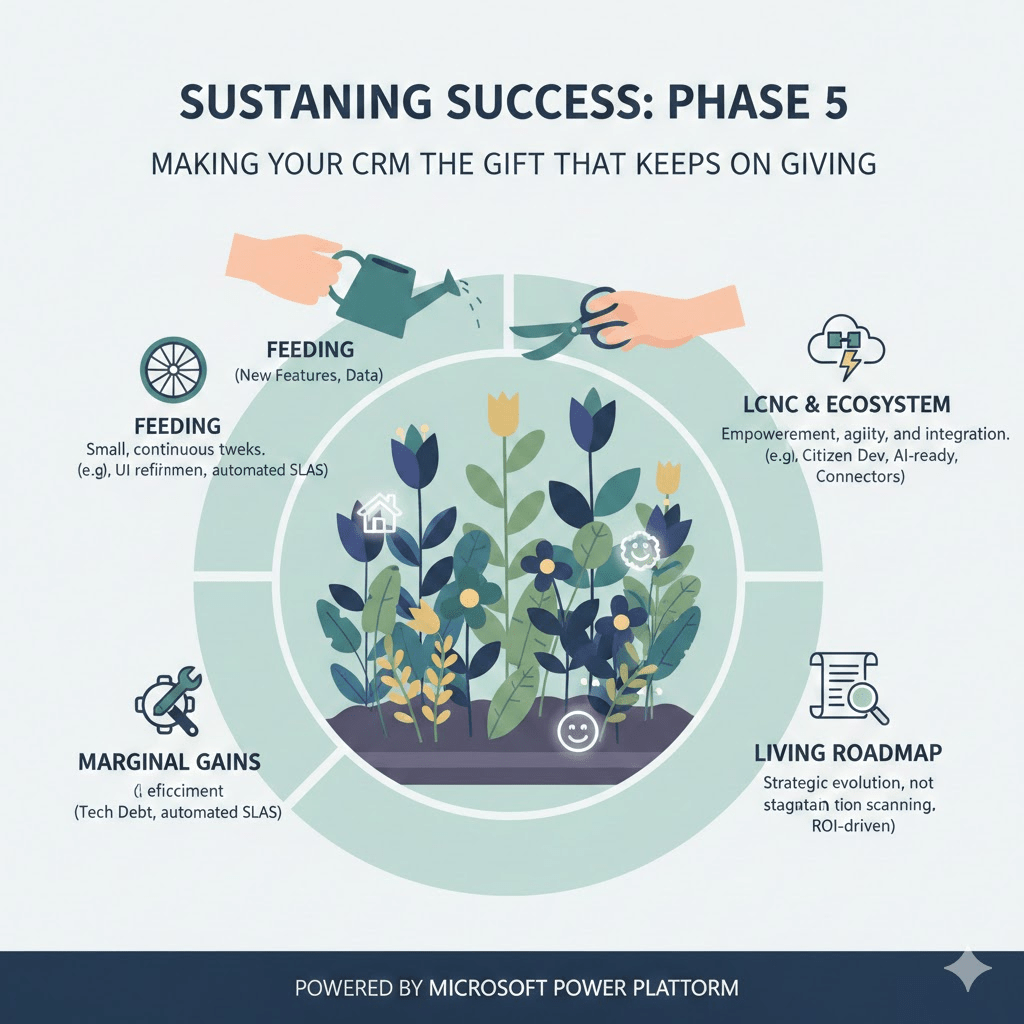
Like a well-maintained garden, a CRM system needs continuous pruning and feeding. Ignoring it means allowing weeds (old processes and technical debt) to choke the life out of your prize-winning blossoms (excellent service and efficiency). Phase 5 ensures we are always tending the garden, not just admiring the initial planting.
What’s the main challenge you’re facing?
We need a quick proof of concept to help back our business case: Struggling to secure funding for your #Dynamics or #Powerapps implementation? Need to show what they can do? then this is for you
Our business case has been approved but we need help to get going: We know that it can be overwhelming. Where do you start, how do you bring your business case to life? Our #D365ForHousing package can help you get going
We’ve started our Dynamics/Power Apps project but struggling to find the time to gather some serious momentum: This is a tough one, the will is there and everyone is up for it but you just struggle to find the time to get things moving while you do the ‘day job’. Our project support service can help lighten the load
We just need a bit of training or access to some handy templates: Then this Business Analysis 101: A Simple and Effective Course for Non-BAs course may be of use or perhaps visit our store to access some handy templates

Hi, I’m Chris Roberts, Director at E&F Solutions.
I’m a Dynamics consultant helping UK housing associations escape rigid legacy CRM systems and overpriced suppliers.
With over 20 years in housing operations, I specialise in translating complex user needs into precise plans. This ensures we deliver a system your teams genuinely love, freeing up funds to be reinvested into building new homes & communities.