

Windows 365 Wednesdays – Windows 365 Explained
A practical look at Windows 365, including architecture, Business vs. Enterprise, licensing, benefits, trade-offs, and where it fits.
Most organizations want the same thing from modern endpoint computing: a Windows experience that is secure, flexible, easy to manage, and available from anywhere. The problem is that getting all of that at the same time has never been simple. Traditional laptops solve one part of the puzzle, and classic VDI solves another, but both usually come with trade-offs in complexity, cost, or user experience.
That is why Windows 365 has become such an interesting option for IT teams: it aims to deliver the simplicity of a managed endpoint with the flexibility of cloud-delivered desktop computing.
Windows 365 is Microsoft’s Cloud PC platform, delivering a persistent, personalized Windows desktop from the Microsoft Cloud to virtually any endpoint. Rather than running Windows locally on a physical device, users connect to a dedicated Cloud PC hosted in the Microsoft Cloud.
In this first post in the series, I want to walk through the fundamentals and give some practical context around:
- What Windows 365 is
- The differences between Business and Enterprise
- Licensing basics
- Key advantages and disadvantages
- When Windows 365 makes sense and when it doesn’t
So, What Is Windows 365 Really?
If you come from a traditional VDI background, the easiest way to think about Windows 365 is as a managed Cloud PC service that hides much of the underlying complexity from both IT and end users.
A Cloud PC is a persistent Windows desktop hosted in Microsoft Cloud. Each user is assigned a dedicated environment that retains core state across sessions, including:
- Applications
- Settings
- Data
- User profile
- Management policies
From the user perspective, the goal is to make the session feel as close as possible to working on a physical Windows endpoint.
From an IT perspective, Cloud PCs are managed similarly to physical Windows endpoints through Microsoft Intune.
Users can access their Cloud PC through multiple client options, including:
- Windows
- macOS
- Linux
- iPadOS
- Android
- HTML5 browser sessions
Because compute and state live in the cloud, the local endpoint matters a lot less than it does in a traditional desktop model. In my experience, that makes Windows 365 especially useful in scenarios such as:
- Contractors
- Temporary workers
- Bring your own device (BYOD)
- Secure admin workstations
- Remote employees
- Shared or shift-based frontline scenarios
- Disaster recovery workspaces
Windows 365 Business or Enterprise?
One of the first decisions you need to make is which Windows 365 edition actually fits your environment.
The two primary editions are:
- Windows 365 Business
- Windows 365 Enterprise
On paper, the editions can look fairly similar. In practice, the differences show up quickly once you look at management depth, networking, and integration with the rest of the Microsoft stack.
| Feature | Business | Enterprise |
|---|---|---|
| Intune integration | Limited | Full |
| Networking control | Microsoft managed | Azure Network Connection |
| Conditional Access | Limited | Full |
| Custom images | No | Yes |
| Granular management | Limited | Extensive |
| Hybrid support | No | Yes |
| Best suited for | Small organizations | Enterprise environments |
The practical distinction is simple:
- Business is built for simplicity.
- Enterprise is built for control and scalability.
If you are already invested in Microsoft Intune and Microsoft Entra ID, Enterprise will usually be the more logical option and in many cases, the one you will probably want long term.
Let’s Talk About Licensing
If there is one area where people tend to pause with Windows 365, it is licensing. The platform itself is straightforward, but the licensing story needs a bit more attention.
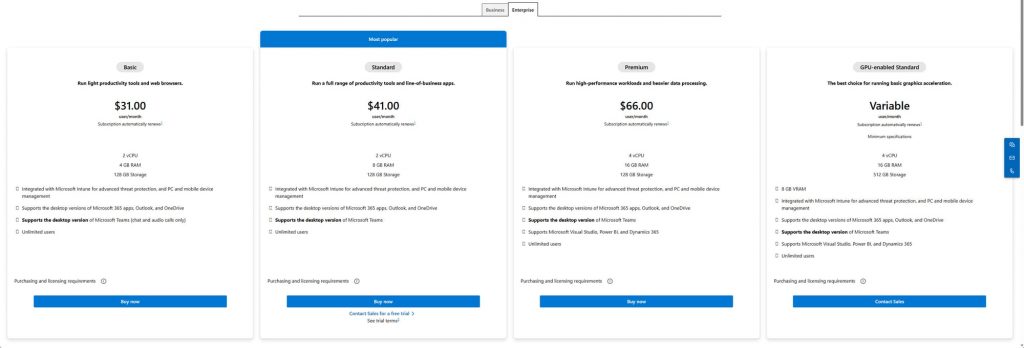
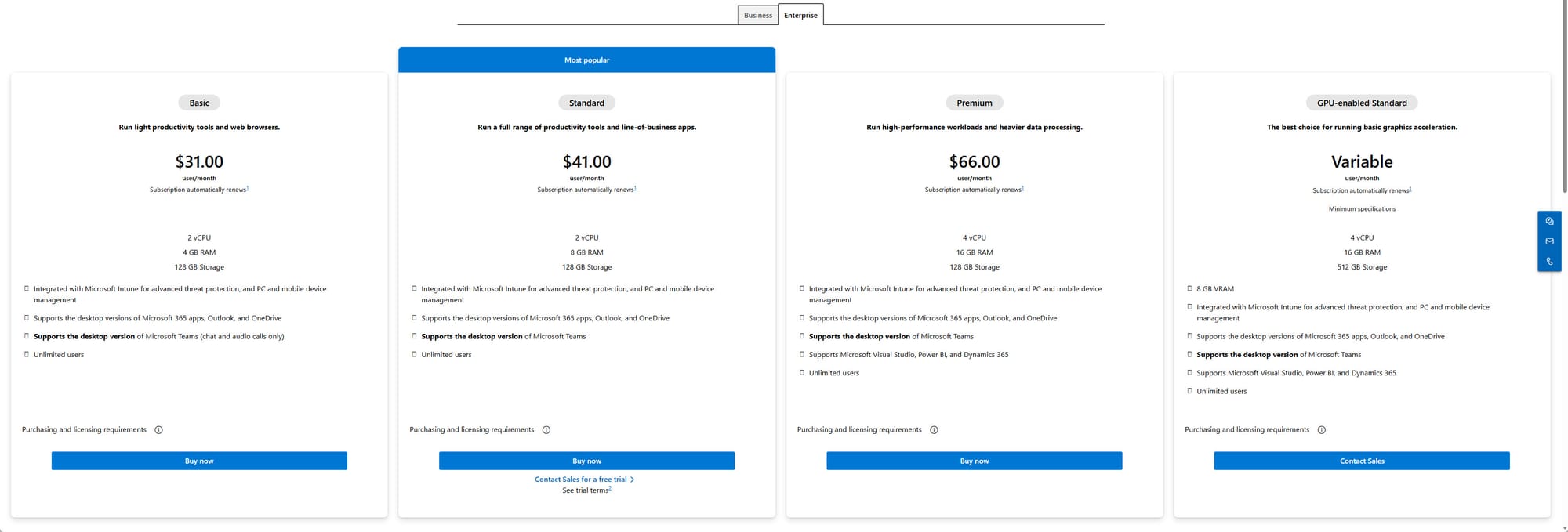
In most cases, licensing is determined by four variables:
- vCPU
- RAM
- Storage
- User assignment
Each licensed user is assigned a dedicated Cloud PC with a fixed hardware profile.
Common examples include:
- 2 vCPU / 8 GB RAM / 128 GB storage
- 4 vCPU / 16 GB RAM / 256 GB storage
- And so on
Check this website for all Cloud PC SKUs.
A few licensing details matter in practice:
- Windows 365 Business includes the Windows license.
- Windows 365 Enterprise requires additional Microsoft licensing prerequisites.
- Windows 365 Flex (Frontline) licensing is available for shift-based scenarios.
- GPU-enabled Cloud PCs are available for specialized workloads.
Microsoft also differentiates licensing and deployment models based on:
- Microsoft-hosted networking
- Customer-managed networking
- Dedicated versus shared usage scenarios
This is one of those areas where proper sizing really matters. If you choose the wrong SKU, cost can climb quickly, so it is worth mapping licenses to actual user behavior and workload requirements rather than guessing.
Why So Many Organizations Are Looking at Windows 365
What makes Windows 365 compelling is that it is not just another virtualization platform. For a lot of organizations, it is a way to standardize desktop delivery without taking on the full complexity that usually comes with VDI.
Simplicity
Compared with traditional VDI platforms, Windows 365 is generally easier to deploy, govern, and operate.
In many environments, provisioning can be completed in minutes rather than weeks.
Consistent user experience
Users work on the same desktop experience regardless of:
- location
- device
- network
That consistency translates into a more predictable support model.
Security
Because corporate data remains inside the Cloud PC session, organizations can reduce the risk of data exposure on unmanaged or personally owned devices.
When combined with controls such as:
- Conditional Access
- Microsoft Intune
- Defender for Endpoint
Windows 365 can play a strong role in a Zero Trust endpoint strategy.
Fast onboarding
Need to bring a temporary worker online quickly?
In practical terms, that means you can assign a license, apply a provisioning policy, and have a desktop ready for the user very quickly.
Reduced dependency on hardware
It also reduces the pressure on local hardware, because most of the heavy lifting happens in the cloud rather than on the endpoint itself.
Where Windows 365 Is Not the Best Fit
As with most cloud services, the strengths of Windows 365 are also what define its boundaries. It is a great fit in many environments, but not in every scenario.
Monthly operational costs
Cloud PCs introduce recurring subscription costs that can become significant at scale.
This is especially relevant for:
- power users
- GPU workloads
- 24/7 usage
Internet dependency
Without a stable and well-performing internet connection, the user experience can degrade quickly.
Latency, packet loss, and network quality still matter.
Not every workload fits
Workloads that depend on intensive graphics, very low latency, or specialized peripheral integration may be better served by other solutions.
Less flexibility than traditional AVD
Compared with Azure Virtual Desktop, Windows 365 gives you less architectural flexibility by design. That is not necessarily a weakness, it is part of the value proposition but it does mean AVD may still be the better option for more specialized scenarios. AVD gives more flexibility around multi-session, pooled desktops, application streaming, and custom architecture designs.”
In many cases, that trade-off is exactly the point, but it is still a trade-off.
So When Does Windows 365 Make Sense?
From my perspective, Windows 365 delivers the most value when organizations are looking for:
- Predictable management
- A simplified VDI model
- Strong integration with Intune
- Rapid deployment
- Secure remote work
- Lower operational overhead
Typical scenarios include:
- Consultants
- Remote employees
- Outsourced teams
- Mergers and acquisitions
- Temporary projects
- Secure admin environments
- Shared desk setups
Final Thoughts
For me, the most important thing to understand about Windows 365 is that it is not simply “VDI in Azure.”
It is Microsoft’s attempt to modernize endpoint delivery by combining cloud management, identity, security, and desktop virtualization into a more standardized operating model. That is exactly why it resonates with so many organizations that want the benefits of cloud-delivered desktops without building and maintaining a full VDI platform themselves.
If you are already standardized on the Microsoft ecosystem, especially Intune and Entra ID, Windows 365 can be a very strong addition to your endpoint strategy.
In the next post in this series, I’ll build out a Windows 365 Enterprise environment and walk through the provisioning flow in Microsoft Intune step by step.
That is it for now. Until next time. 👋